"The Nocardia foam that was overflowing our splitter box has settled right down. We started seeing a difference within three weeks."
Sarah Mitchell
Operations Manager, Riverview Treatment Plant
Activated sludge plants, aeration basins and wastewater treatment systems prone to Nocardia and Microthrix foam
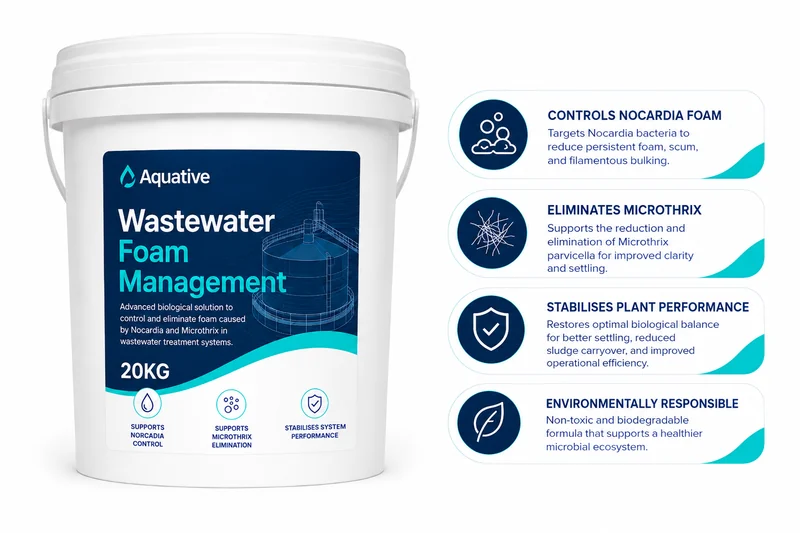
Advanced biological solution to control and eliminate persistent foam caused by Nocardia and Microthrix in wastewater treatment systems. Targets foam-forming filamentous bacteria, supports microbial balance and improves settling, clarity and operational stability.
| Product form | Concentrated dry biological powder / granule blend in a 20 kg pail |
|---|---|
| Pack size | 20 kg pail |
| Dosing format | Broadcast directly onto the aeration basin surface, or mix with plant water and dose via return activated sludge (RAS) line or basin feed |
| Typical dose frequency | Daily to weekly, depending on foam severity and plant flow; site-specific program provided by Aquativ |
| Application system | Aerobic activated sludge, SBR, aerated lagoons and oxidation ditches |
| Storage guidance | Store in a cool, dry place out of direct sunlight. Keep pail sealed when not in use. Avoid extreme heat or freezing conditions |
| Shelf life | 24 months unopened when stored as recommended |
| Compatibility | Compatible with Aquative BOD / COD Reducer, Sludge Reducer and other aerobic biological programs. Not intended for anaerobic digesters or covered lagoons |
| Safety notes | Non-toxic, biodegradable and non-hazardous. Avoid inhalation of dust and wear standard PPE when handling. SDS available on request |
What plant operators and wastewater professionals say about this product.
"The Nocardia foam that was overflowing our splitter box has settled right down. We started seeing a difference within three weeks."
Sarah Mitchell
Operations Manager, Riverview Treatment Plant
"We had tried defoamer after defoamer. This was the first approach that actually changed the biology behind the foam instead of just hiding it."
James Carter
Process Engineer, Lakeside WWTP
"Our clarifier is running cleaner and the scum blanket on the surface is much thinner. Dosing is straightforward and the team picked it up quickly."
Emily Thompson
Plant Supervisor, Northern Water Authority
"Foam was making it hard to keep our discharge compliance consistent. Since starting the program our effluent quality has been more stable."
Michael Nguyen
Environmental Compliance Officer, Coastal Utilities
"The operators like that there are no harsh chemicals to handle. It fits neatly into our existing aerobic dosing routine."
Rebecca Harris
Wastewater Technician, Greenfield Municipality
"We were scraping foam off equipment daily. That maintenance has dropped off significantly and the plant looks a lot tidier."
David O'Connor
Maintenance Manager, Eastbrook Processing
"From a process standpoint the shift in filament abundance and improved settling are exactly what we wanted to see. Good support from the Aquativ team too."
Laura Chen
Senior Process Scientist, AquaTech Consulting
"Odour complaints linked to the foamy scum have dropped. The community feedback has been noticeably better this quarter."
Robert Walsh
Works Manager, Southside Council
"We run a high-FOG effluent and foam was a constant headache. The foam depth in the aeration basin is now well under control."
Jessica Park
Environmental Coordinator, Highland Industrial Park
"Easy to store, easy to dose, and the results speak for themselves. Our SVI has improved and the foam is no longer carrying over."
Anthony Miller
Lead Operator, Bayview Treatment Facility
"We needed a non-toxic, biodegradable option that would not interfere with our beneficial biology. This ticked every box."
Michelle Foster
Quality & Compliance Manager, Clearwater Solutions
"The dosing program was tailored to our flow and load. We track foam depth weekly and the trend is clearly downward."
Daniel Lee
Process Control Specialist, MetroWater Services
"We had one stubborn basin that would foam every winter. Last season was the first in years we did not need emergency defoamer."
Stephanie Brown
Treatment Plant Coordinator, Westfield Regional
"Reducing the foam burden has made the whole plant more stable. It is one of the better biological investments we have made recently."
Christopher Evans
Operations Director, Pine Rivers Water
Tell us about your application and we'll match the right biological program.