How FOG and Nocardia Reduce Dissolved Oxygen in Aerated Ponds

Dissolved oxygen (DO) is the single most important control variable in an aerated pond or lagoon. When DO falls, treatment slows, odour rises and the biology shifts towards organisms that make the problem worse. Two of the most common causes of unexplained DO loss in food processing, abattoir, dairy and municipal ponds are fats, oils and grease (FOG) and the filamentous bacterium Nocardia (now largely reclassified as Gordonia and related Mycolata). They work together: FOG feeds Nocardia, Nocardia stabilises foam, and both reduce how much oxygen actually reaches the bacteria doing the treatment.
Why dissolved oxygen matters in aerated ponds
Aerobic bacteria need oxygen to oxidise BOD, convert ammonia and keep sludge from turning septic. Most aerated systems aim to hold a working DO residual, commonly around 1 to 2 mg/L in the mixed liquor, although the right target depends on the design and the treatment objective.
Aerators have a fixed capacity to transfer oxygen. Anything that increases oxygen demand, or reduces how efficiently oxygen is transferred into the water, eats into that margin. FOG and Nocardia do both.
How FOG lowers dissolved oxygen
Fats, oils and grease arrive from kitchens, processing floors, rendering and wash-down. Being lighter than water, much of the FOG floats and forms surface films, scum rafts and grease balls.
- Surface films act as a barrier at the air-water interface, reducing oxygen transfer from surface aerators and natural re-aeration.
- Surfactant-like fatty compounds lower the oxygen transfer efficiency of diffused aeration by changing bubble behaviour, so the same blower energy delivers less oxygen.
- FOG is a high-strength, slowly degraded load. When it is finally broken down it creates a large, sustained oxygen demand.
- Grease coats biomass and flocs, slowing the diffusion of oxygen and substrate into the bacteria.
- Settled and entrained grease feeds anaerobic zones in the sludge blanket, which release reduced compounds such as sulphides that consume oxygen when they reach the aerated layer.
What Nocardia is and why it thrives on FOG
Nocardia-type organisms are branched, filamentous, hydrophobic bacteria. They grow well on long-chain fatty acids and oils, favour long sludge ages and warm water, and are well known for forming thick, brown, stable foam on aeration basins and ponds.
Because their cell walls are waxy and water-repelling, they attach to air bubbles and carry solids to the surface. The result is a persistent foam layer that is hard to knock down with sprays and often returns within days.
How Nocardia foam lowers dissolved oxygen
Nocardia foam reduces DO through several linked mechanisms rather than one.
- A thick foam blanket physically shields the water surface and reduces oxygen transfer from surface aerators.
- Foam traps active biomass at the surface, away from the mixed liquor where treatment and oxygen use should happen.
- Foam and scum can become anaerobic underneath, generating odour and oxygen-demanding by-products that drain back into the pond.
- Operators often increase aeration to fight falling DO, which can strip more bubbles into the foam and make foaming worse.
- Foam carried over to clarifiers or downstream ponds spreads the problem and raises effluent solids and BOD.
Warning signs operators should watch for
The combination of FOG and Nocardia usually shows up gradually. Common signals include:
- DO trending down at the same aeration setting, or aerators running longer to hold the same residual.
- Brown, greasy, stable foam that feels thick or leathery rather than white and bubbly.
- Grease rafts, scum lines or floating mats at the pond edges and corners.
- Rising odour, particularly early morning or after production peaks.
- Microscopy showing branched Gram-positive filaments in the foam and mixed liquor.
- Higher effluent BOD, COD or suspended solids after foaming events.
Practical controls
Lasting control means reducing the FOG supply and changing the conditions Nocardia prefers, not just treating foam as it appears.
- Capture FOG at source with well-maintained grease traps, save-alls and DAF units, and keep upstream pits and pump stations free of grease build-up.
- Physically remove floating scum and foam rather than returning it to the system, where it re-seeds the pond.
- Review sludge age and wasting where the system allows it, as long retention favours Nocardia.
- Keep aeration and mixing even across the pond so dead zones do not accumulate grease and foam.
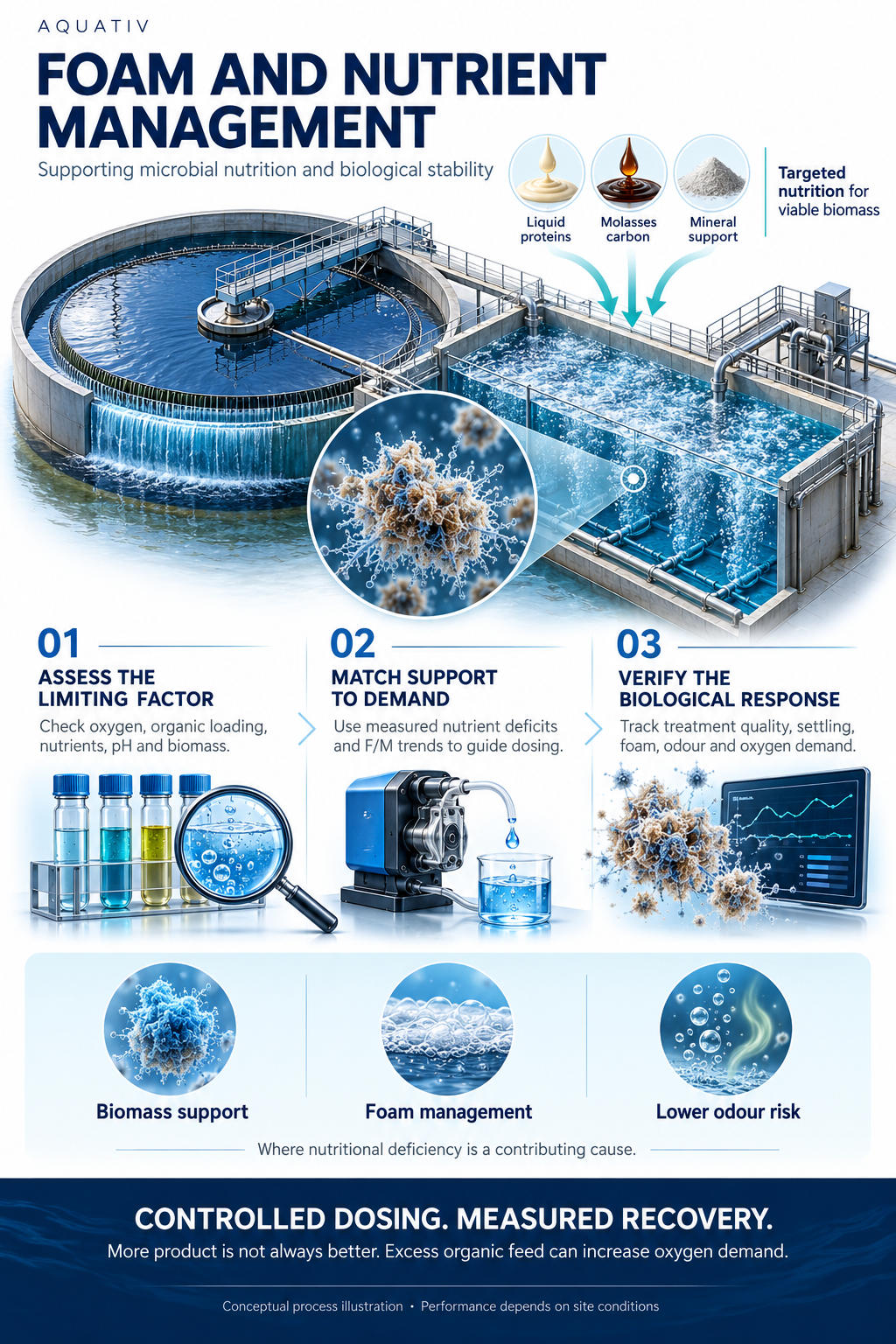
- Use targeted bioaugmentation with lipase-producing bacteria and enzymes to break down FOG earlier, reducing the fatty substrate that feeds Nocardia and the oxygen demand it creates later.
- Track DO, foam depth, odour and effluent results against a site baseline so the effect of each change is visible.
Where biological treatment fits, and its limits
Biological FOG programs support, but do not replace, source control and good pond operation. They cannot fix undersized aeration, hydraulic overload, or toxic and extreme-pH discharges, and results depend on temperature, loading and dosing discipline. Aquativ measures outcomes against each site's own baseline rather than quoting fixed performance figures.
If your aerated ponds are struggling to hold dissolved oxygen, or you are seeing persistent brown foam, send us your system type, flows, DO records and a description of the foam. A wastewater specialist will review the data and propose a program suited to your site.
Related Aquativ solutions
Explore the programs behind the field notes above.
Product range
Biological programs for home, commercial and industrial systems.
ExploreAll wastewater sectors
Eight sectors, from septic to abattoir and municipal plants.
ExploreIn-situ desludging
Microbial plug programs for aerobic and anaerobic lagoons.
ExploreGrease trap treatment
Biological FOG control for kitchens and food venues.
Explore