How Bacteria Break Down Sludge in Wastewater Systems

Sludge accumulation is one of the most persistent operational challenges in wastewater treatment ponds, lagoons, septic systems and biological treatment plants. Over time, fats, proteins, carbohydrates, suspended solids and biological material settle and compact on the bottom of the system. If this accumulation is not managed, it can reduce effective treatment volume, restrict flow, create anaerobic zones, increase odour and place additional pressure on aeration equipment. Beneficial bacteria can help address the biodegradable organic fraction of this sludge. The process is biological rather than instantaneous: selected microorganisms colonise the sludge, produce enzymes and progressively convert complex organic material into simpler compounds.
What does it mean when we say bacteria “dissolve” sludge?
Bacteria do not chemically dissolve every component of sludge. Instead, they biologically degrade and solubilise organic material.
Large organic particles are broken into smaller, soluble compounds that bacteria can absorb and use for energy and cellular growth. Under aerobic conditions, much of this biodegradable material is ultimately converted into carbon dioxide, water and additional biomass. Under anaerobic conditions, the end products may also include methane and other intermediate compounds.
Inert materials - including sand, grit, metals, plastics and mineral solids - cannot be removed through biological treatment and may still require mechanical desludging. The process shown in the Aquativ Solutions illustration above can be understood in five stages.
Stage 1: Sludge accumulates
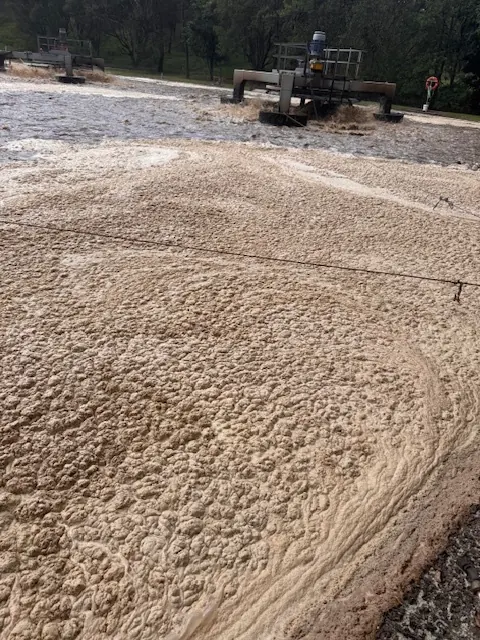
Wastewater carries organic and inorganic solids into the treatment system. Heavier material settles, while fats, proteins, carbohydrates and fine suspended solids gradually combine with biological biomass to form a sludge layer.
The US Environmental Protection Agency notes that excessive lagoon sludge can reduce effective retention time and contribute to treatment and compliance problems. The agency recommends measuring sludge depth as part of routine lagoon assessment.
- Reduced available treatment volume and hydraulic retention time
- Restricted circulation and oxygen transfer
- Stagnant or anaerobic pockets
- Increased risk of septic conditions and odour
- Interference with pumps, pipework and aeration equipment
- Elevated BOD, suspended solids or ammonia
- More frequent and costly mechanical desludging
Stage 2: Beneficial bacteria colonise the sludge
The next stage is colonisation. Beneficial bacteria attach to the surface of the sludge and establish biological communities within its pores, cracks and softer organic layers. This attachment is important because the bacteria need close contact with the material they are degrading. Once established, the population can multiply when suitable food, moisture, temperature, pH and environmental conditions are available.
A properly selected bacterial consortium may contain organisms capable of targeting different organic components. Some are more effective at degrading fats and oils, while others target proteins, starches, carbohydrates or general organic solids. However, adding bacteria alone does not guarantee sludge reduction. The organisms must remain active and competitive within the actual wastewater environment.
Stage 3: Enzymes break down complex organic material
Bacteria produce extracellular enzymes that act outside the bacterial cell. These enzymes function like specialised biological tools, cutting large organic molecules into smaller pieces.
This stage is called hydrolysis. It is critical because bacteria cannot directly absorb most large or insoluble organic particles. The material must first be converted into smaller soluble compounds capable of passing through the bacterial cell membrane.
- Lipases help break down fats, oils and grease
- Proteases break proteins into peptides and amino acids
- Amylases break starches and carbohydrates into simpler sugars
- Cellulases assist with biodegradable plant and fibrous material
Stage 4: Organic sludge is biodegraded and stabilised
After hydrolysis, bacteria absorb the smaller compounds and use them as a source of carbon and energy. In an aerobic environment, bacteria use oxygen and primarily produce carbon dioxide, water and new biomass. In an anaerobic environment, microbial communities progressively convert organic material into organic acids, methane, carbon dioxide and stabilised residual solids. In a facultative environment, both processes may occur in different layers of the pond.
Anaerobic digestion is a recognised biological process for stabilising wastewater solids and reducing their biodegradable organic content. As the volatile organic fraction is consumed, the sludge can become less bulky and more stabilised. The achievable reduction depends on the sludge composition, operating conditions and proportion of inert material.
Stage 5: A cleaner, more efficient treatment system
As biodegradable sludge is progressively reduced, the treatment system may recover useful operating capacity and function more efficiently. These benefits are not automatic and should be verified through sludge-depth surveys, operational monitoring and water-quality data.
- Reduced organic sludge volume
- Improved circulation and hydraulic flow
- Better oxygen distribution
- Reduced localised anaerobic activity
- Lower odour potential
- Improved access to pumps and aeration equipment
- Longer intervals between mechanical desludging events
- More stable biological treatment performance
What conditions do beneficial bacteria need?
Biological sludge reduction performs best when the wastewater environment supports microbial activity. Aerobic organisms require adequate dissolved oxygen, and mixing brings bacteria, enzymes and organic material into contact while helping prevent further solids deposition. In anaerobic zones, oxygen is not required, but stable loading, temperature, pH and sufficient retention time remain important.
Extreme pH can suppress or destroy biological activity, and most general wastewater bacteria perform best near neutral pH. Biological reactions generally slow as water temperature decreases, so seasonal variation must be considered when setting realistic treatment timeframes. Sudden increases in fats, solids, cleaning chemicals or high-strength wastewater can overwhelm the biological population, meaning source control and load balancing may be required alongside bioaugmentation.
Disinfectants, oxidising agents, strong acids, strong alkalis, solvents, heavy metals and some cleaning chemicals may inhibit beneficial bacteria. The treatment program should therefore consider the site's complete chemical discharge profile.
Biological treatment is not a substitute for every form of desludging
A credible sludge-management program begins by determining what is actually present in the pond or tank. Biological treatment is best suited to biodegradable organic sludge and will not remove significant quantities of sand, grit, soil, silt, plastic, metal, mineral deposits or other non-biodegradable solids.
Deep, heavily compacted or predominantly inorganic deposits may still require mechanical removal. Biological treatment can instead form part of an integrated strategy - reducing the degradable fraction, improving ongoing sludge control and potentially extending the time between major desludging events. The EPA similarly recognises that lagoon bacteria break down organic waste while accumulated sludge still requires periodic physical removal.
How should a biological desludging program be measured?
Before treatment begins, the plant should establish a defensible baseline. The same measurements should be repeated during and after treatment, with sludge-depth readings taken from consistent, documented locations so changes can be compared accurately.
Operators should also monitor the liquid phase. Biological breakdown can temporarily release soluble organic material, ammonia or phosphorus from the sludge into the water column, so the system must have sufficient downstream biological capacity to treat these released compounds.
- Sludge-depth and volume survey
- Sludge sampling for organic and inorganic composition
- BOD and COD
- Total and volatile suspended solids
- Dissolved oxygen and ORP
- pH and temperature
- Ammonia and nutrient concentrations
- Oil and grease
- Flow and hydraulic retention time
- Odour observations and aeration performance
A smarter approach to sludge management
Mechanical desludging remains essential when a system contains excessive inert material or severely accumulated deposits. However, relying exclusively on physical removal treats the accumulated sludge without necessarily addressing the conditions that caused it to build up.
A more sustainable strategy combines sludge profiling and measurement, control of incoming fats, oils and solids, adequate aeration or managed anaerobic conditions, targeted biological treatment, routine performance monitoring and planned removal of residual inert material. This shifts sludge management from a reactive clean-out exercise to an ongoing biological optimisation program.
Harnessing biology for better wastewater performance
Beneficial bacteria are already central to wastewater treatment. A targeted bioaugmentation program builds on this natural process by introducing microbial capabilities suited to the waste stream and treatment objective. When supported by the right operating conditions, biological sludge reduction can help decrease biodegradable deposits, improve system efficiency and reduce the operational impact of recurring sludge accumulation.
Aquativ Solutions develops practical biological treatment programs for ponds, lagoons and industrial wastewater systems. Each program should begin with an assessment of the sludge profile, wastewater characteristics and operating conditions so that treatment objectives can be established and independently measured. Talk to Aquativ Solutions about a sludge survey and site-specific biological treatment program. Better for your plant. Better for the environment.
Related Aquativ solutions
Explore the programs behind the field notes above.
Product range
Biological programs for home, commercial and industrial systems.
ExploreAll wastewater sectors
Eight sectors, from septic to abattoir and municipal plants.
ExploreIn-situ desludging
Microbial plug programs for aerobic and anaerobic lagoons.
ExploreGrease trap treatment
Biological FOG control for kitchens and food venues.
Explore