
In-Situ Desludging With Targeted Bioaugmentation
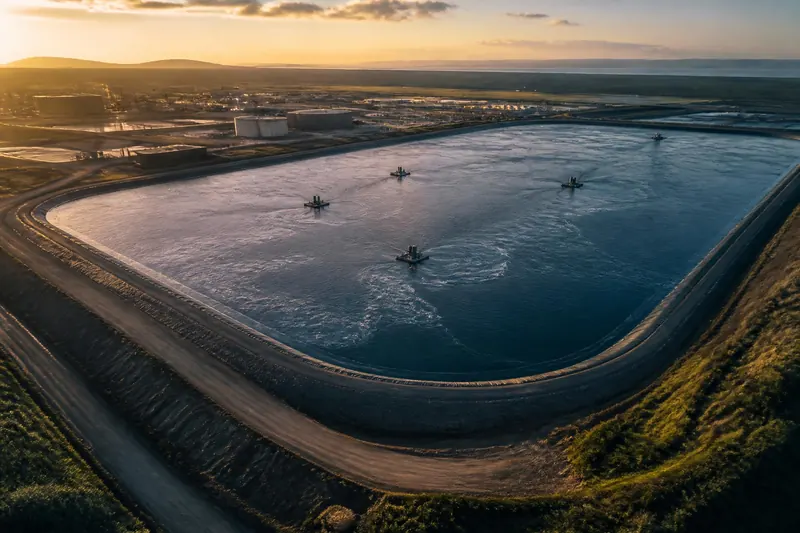
Every lagoon and pond fills up. Sludge builds in the dead zones, residence time drops, treatment performance slides, and eventually someone quotes you a six-figure dredging job with tankering and disposal on top. Mechanical desludging works, but it is expensive, disruptive, and on a covered lagoon it can mean pulling a cover you spent a fortune installing. In-situ bioaugmentation offers a different route: deliver the right organisms directly onto the sludge and let them digest it in place. It is not magic, and it does not suit every pond. On the right sludge, placed correctly, it can defer or replace a dredge for a fraction of the cost.
What the bugs actually do, and what they don't
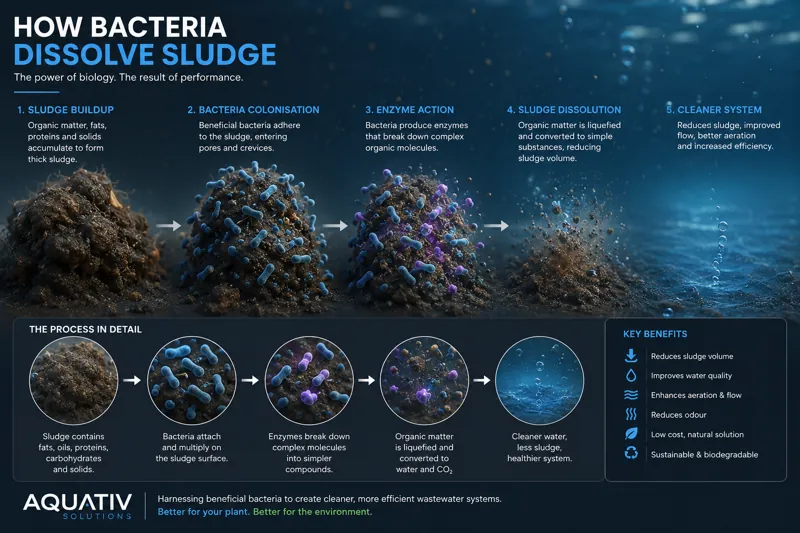
The organisms that matter here are mostly Bacillus and related Firmicutes, selected because they produce extracellular hydrolytic enzymes: proteases, lipases, amylases and cellulases. Accumulated sludge is largely particulate organic matter locked up in a form the resident community breaks down slowly. Hydrolysis is the rate-limiting step. Seeding the sludge layer with a high density of enzyme-producing organisms accelerates the breakdown of that organic fraction into soluble products, which the wider microbial community then mineralises.
Here is the limit, stated plainly, because it decides whether a program will work at all: bioaugmentation reduces the volatile (organic) fraction of sludge only. It does nothing to grit, sand, silt, struvite or other inert mineral solids. If your sludge is mostly washed-in silt or fixed solids, no product will dissolve it and you are back to a dredge.
So the first question is never 'which product,' it is 'what is my sludge made of.' A simple volatile-solids to fixed-solids split tells you your ceiling before you spend a dollar. Documented field programs on organic-rich sludge report volatile solids reductions in the order of 15 to 25 percent over a treatment season. That is the realistic prize: a meaningful cut in the biodegradable fraction, not the removal of the pond floor.
Placement is the whole game
This is where distributing the organisms across the actual buildup earns its keep. Broadcasting product across the water surface mostly feeds the water column and washes out with the flow. The bacteria need to reach the sludge, at the depth and location where it has accumulated. Dense, weighted formats - tablets, sticks or spikes that sink and dissolve slowly at the sediment interface - carry the bacteria, enzymes and nutrients down to the substrate instead of leaving them in the overlying water.
Sludge maps tell you where to aim. Depth soundings across a grid show the drifts, and they are almost always in the same places: the inlet, the corners, and the hydraulic dead zones where mixing is poor. You dose those zones, not the whole pond. Targeted spot-dosing of known accumulation areas is both cheaper and more effective than blanket application, and it is the difference between a program that works and a product that gets poured and forgotten.
Aerobic systems: keep the plant running
The case for treating an aerated lagoon or pond biologically is really a case against the disruption of the mechanical alternative. Dredging or slurry injection in an aerated system usually means isolating a cell or taking it offline, and disturbing the settled blanket. That resuspension throws a shock load of oxygen demand and released nutrients onto the rest of the treatment train, exactly when you have reduced capacity to absorb it. The realistic worst case is an effluent excursion at the worst possible time.
In-situ biological reduction avoids that. The pond keeps treating under load while the sludge is worked down gradually from below. Where surface aerators exist, repositioning them to lift and re-suspend settled drifts into oxygenated, bacteria-rich water accelerates the process. Do that in the warmer months, when dissolved oxygen and biological rates are naturally higher and the lagoon can carry the extra load. Temperature is not a footnote here: these are biological rates, and they fall sharply as the sludge cools, so winter dosing buys you very little.
Anaerobic systems and covered lagoons: the access argument
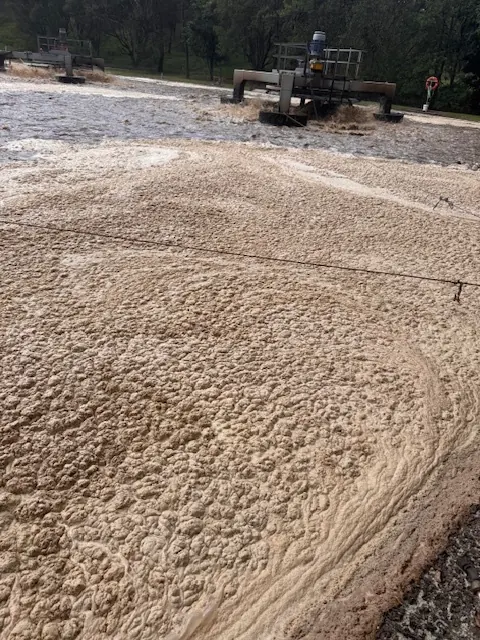
This is where the economics get compelling, and also where the engineering needs the most care. Covered anaerobic lagoons at abattoirs, dairies and piggeries capture biogas and control odour, but they suffer from two chronic problems: sinking sludge layers and a floating fat or crust layer. Both shrink the active volume, cut residence time and choke gas yield.
Mechanically desludging a covered lagoon is brutal: you deflate or remove a gas-tight cover, manage the exposed anaerobic mass and its odour, then re-seal and re-commission. Dosing product through a small purpose-cut access port, resealed by welding, is a fraction of that cost and leaves the cover and the biogas system intact. On a covered lagoon, that access difference is often the entire business case.
The mechanism inside an anaerobic lagoon is not the same as the aerobic one, and it is worth being precise about, because getting it wrong is how these programs fail. You are not adding oxygen-hungry organisms to burn off sludge. You are reinforcing the rate-limiting hydrolysis and acidogenesis steps so that trapped particulate organics are broken down and fed into the existing methanogenic community. Done well, that can lift biogas output rather than compete with it. Done carelessly, it backfires. Overload the hydrolysis step without matching methanogenic capacity and you accumulate volatile fatty acids, drop the pH, and sour the lagoon.
Protein-heavy abattoir and rendering loads add a second trap. Protein hydrolysis releases ammonia, and free ammonia at elevated levels inhibits the very methanogens the lagoon depends on. So an anaerobic dosing program is a staged, monitored exercise, not a single pour. You track VFAs, alkalinity, pH and ammonia, and you dose in step with what the system can convert.
Where it pays off, by sector
Not every organic waste stream behaves the same way. The candidates below are where in-situ bioaugmentation has the strongest technical case, subject to the sludge characterisation above.
- Abattoirs and meat processing. High in fats, oils, grease and protein. FOG is highly biodegradable, so lipase and protease producers work directly on both the settled sludge and the surface crust that blinds covered lagoons and blocks accurate biogas capture. A strong candidate, subject to the ammonia guardrail above.
- Municipal ponds and lagoons. Decades-old facultative and aerated systems running near capacity. Organic-rich domestic sludge responds well. The variable to check is washed-in grit and stormwater silt, which sets the ceiling on how much you can actually reduce.
- Dairy operations and effluent ponds. Manure and washdown solids carry a high biodegradable load and respond well. Watch inorganic bedding sand and grit, which are inert and will not move.
- Piggery and farm ponds. High-solids slurry with a strong organic fraction, well suited to staged in-situ programs and to low-rate maintenance dosing that stays ahead of accumulation instead of chasing it.
Run it as a program, not a product
The common failure mode is treating bioaugmentation as a one-off pour and expecting the pond to empty. The conditions that built the sludge - short-circuiting, dead zones, overloading, low dissolved oxygen - are still there the day after you dose. Durable results come from a program:
- Characterise the sludge first: the volatile-to-fixed solids split, plus a depth map to locate the drifts.
- Dose the accumulation zones with sinking product that reaches the sediment interface.
- Hold the conditions that favour the organisms: temperature and dissolved oxygen for aerobic systems, stable pH, alkalinity and controlled loading for anaerobic ones.
- Re-sound the sludge and re-measure volatile solids to prove the reduction, rather than assuming it.
- Once levels are down, switch to low-rate maintenance dosing to hold them there and push the next capital dredge out indefinitely.
Bottom line
In-situ bioaugmentation is not a way to dredge silt, and it is not a magic pour. It is a targeted, lower-cost way to reduce the organic fraction of accumulated sludge in place, keep aerobic systems running through the process, and avoid tearing the cover off an anaerobic lagoon to get at the problem.
Characterise the sludge, place the organisms where the buildup actually is, hold the right conditions, and measure the result. On the right pond, that is where it delivers - and being straight about where it doesn't is what earns the operator's trust to run it where it does.
Related Aquativ solutions
Explore the programs behind the field notes above.
Product range
Biological programs for home, commercial and industrial systems.
ExploreAll wastewater sectors
Eight sectors, from septic to abattoir and municipal plants.
ExploreIn-situ desludging
Microbial plug programs for aerobic and anaerobic lagoons.
ExploreGrease trap treatment
Biological FOG control for kitchens and food venues.
Explore