
Wastewater Foam Management: Why Operators Struggle and How to Identify and Correct the Root Cause
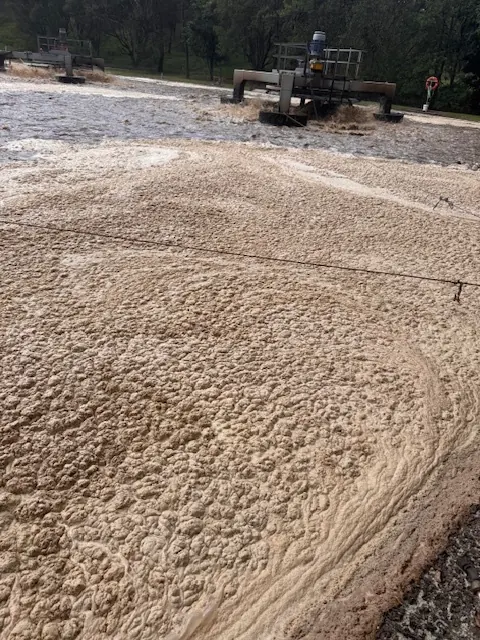
Foam is one of the most visible - and frequently misunderstood - warning signs in a wastewater treatment plant. A small amount of temporary white foam may be harmless. However, thick brown biological foam can reduce oxygen transfer, trap solids, create odour, interfere with level instrumentation, overflow walkways and contribute to suspended-solids carryover. In severe cases, foam becomes a self-sustaining biological reservoir that repeatedly returns problem organisms to the treatment process. The central mistake is treating all foam as the same problem. Foam is not a diagnosis. It is a process symptom that may be caused by surfactants, fats and oils, filamentous bacteria, low dissolved oxygen, excessive sludge age, an incorrect F:M ratio, septicity, nutrient deficiency, hydraulic shock loading or several of these conditions occurring simultaneously. Effective wastewater foam management therefore requires a structured investigation rather than simply applying a defoamer.
Why wastewater operators struggle with foam
Wastewater operators generally do not struggle because they lack experience. They struggle because several different process failures can produce a similar surface appearance.
A stable tan or brown foam may indicate excessive growth of hydrophobic filamentous organisms such as Microthrix or nocardioform organisms, including bacteria associated with the genera Gordonia, Skermania and Rhodococcus. These organisms can attach to air bubbles and accumulate at the surface, particularly when fats, oils and grease are available.
However, brown material floating in a secondary clarifier may not be biological foam at all. It may be rising sludge caused by denitrification, excessive sludge-blanket retention, gas formation or septic conditions. Operators therefore face five recurring challenges: foam has multiple possible causes; the process responds slowly, so today's foam may reflect a shift that started days ago; the causes often overlap; grab samples miss short-duration peak loads; and immediate cosmetic control with sprays or antifoams is often mistaken for process control. Collapsing the foam can simply return concentrated filamentous biomass to the aeration basin.
Understanding the role of F:M ratio
The food-to-microorganism ratio compares the organic load entering the biological reactor with the active biomass available to treat that load. A simplified F:M calculation is: F:M = Q x S0 / (V x X), where Q is influent flow, S0 is influent BOD or COD concentration, V is biological reactor volume and X is MLVSS concentration. The result is normally expressed as kilograms of BOD - or COD - applied per kilogram of MLVSS per day.
BOD and COD should not be interchanged without understanding the relationship between them. The plant should also use MLVSS rather than MLSS where practical, because MLVSS provides a better estimate of the biological fraction of the mixed liquor. F:M, solids-retention time, solids inventory and settleability are interconnected process-control indicators. The US EPA identifies F:M, SRT and SVI as important calculations for controlling activated-sludge solids and establishing a stable operating condition.
When F:M is too high
A high F:M ratio means the plant has a relatively high food load compared with the available biomass. This may occur during plant start-up, biomass loss, excessive sludge wasting, hydraulic or organic shock loading, clarifier solids washout, inadequate return sludge, or sudden increases in production waste.
The solution is not automatically to increase aeration. The operator must determine whether the primary limitation is oxygen, biomass inventory, retention time, nutrients or excessive incoming load.
- White, loose or billowing foam
- Rapid oxygen consumption
- Poor floc development and dispersed bacterial growth
- Pin floc and elevated effluent suspended solids
- Reduced nitrification
When F:M is too low
A low F:M ratio means there is a large biomass inventory relative to the available biodegradable load. This is commonly associated with excessive MLSS, excessive SRT, insufficient sludge wasting, reduced production load, extended aeration or a large inactive/inorganic solids inventory.
Low F:M conditions can favour organisms that compete effectively when readily biodegradable substrate is limited. Several filamentous organisms associated with bulking and foam are linked to low F:M conditions, particularly when low oxygen, lipids or septicity are also present. There is no universal ideal F:M ratio. The correct operating range depends on the process configuration, wastewater composition, temperature, nutrient-removal requirements, sludge age and treatment objectives. The objective is not to chase a textbook number, but to establish the plant-specific operating window that consistently produces good treatment, stable floc and reliable clarification.
- Thick tan or brown foam and greasy, stable surface scum
- Slow settling and high SVI
- Excessive rotifers or higher organisms
- Ash-like floc and endogenous biomass decay
- Poor sludge compaction
Reading the appearance of foam
Foam appearance provides useful preliminary information, but it should never be used as the sole diagnosis. White, light and unstable foam often reflects young sludge, high F:M, start-up conditions, surfactant or detergent loading, low MLSS or poor floc formation. Tan or light-brown stable foam suggests increasing sludge age, low F:M, early filamentous growth, FOG entering the biological process, foam recycling or poor surface removal - and should trigger microscopy and a review of FOG, wasting, MLSS, SRT and DO trends.
Thick, dark-brown or greasy foam is commonly associated with nocardioform organisms, Microthrix, high lipid or long-chain fatty-acid loading, excessive sludge age, low F:M and uncontrolled foam recycling. Microthrix is strongly associated with lipids, low F:M, lower dissolved oxygen and, in many systems, cooler temperatures. Floating brown solids in a clarifier may be mistaken for foam but can indicate denitrification in the sludge blanket, excessive clarifier solids-retention time, high nitrate, deep blankets, low RAS withdrawal, septicity or gas attachment to biological floc. Look for gas bubbles rising through settled sludge and check whether the solids are floating clumps rather than stable aerated foam.
A structured foam investigation
Step 1 - Document the foam before changing the process. Record colour, thickness, stability, texture, odour, location, percentage of surface coverage, time first observed, production activity at the time, whether the foam collapses with a water spray and whether it returns immediately after removal. Photographs taken from the same position each shift provide an effective trend record.
Step 2 - Check instrument accuracy. Before changing the process, confirm that DO, pH, ORP, flow meters, MLSS testing, pump rates and RAS/WAS flow measurements are reliable. A plant cannot be controlled effectively with an uncalibrated DO probe or an assumed wasting rate. DO should be profiled across the reactor - a single reading near an aerator may look acceptable while other zones remain oxygen deficient.
Step 3 - Establish the actual solids inventory. Measure aeration-basin MLSS, MLVSS, RAS and WAS concentrations, clarifier sludge-blanket depth, total biological solids inventory, actual SRT and actual daily wasting mass. Do not rely only on the WAS pump setting - it may be partially blocked, worn, incorrectly calibrated or working against changing head pressure.
Step 4 - Calculate F:M and organic loading. Use flow-weighted influent BOD or COD data and compare with the plant baseline. Investigate daily load, peak-hour load, load per aeration volume, load per operating aerator, weekend or shutdown loading, changes in biodegradable versus inert COD, and return loads from sludge handling. An apparently low F:M based on total COD can be misleading when much of the COD is slowly biodegradable or inert.
Step 5 - Conduct settleability testing. Perform a 30-minute settleometer test and record initial settling rate, settled sludge volume, floc size, supernatant clarity, pin floc, rising sludge, gas formation and floating material. Calculate SVI where appropriate.
Step 6 - Use microscopy. Microscopy is one of the most valuable foam-management tools available. Assess floc size and density, filament abundance and location, dispersed bacteria, protozoan population, higher organisms, and Gram/Neisser staining where required. The dominant filament often provides evidence of the environmental condition selecting for it.
Step 7 - Investigate the influent and internal returns. Inspect grease traps, DAF performance, primary clarification, balance tanks, long rising mains, sludge dewatering returns, digester supernatant, septic tank discharges, production washdown schedules, detergent and sanitiser use, and fat, protein, blood, dairy or oil losses. In industrial plants, the source of the foam may be upstream of the wastewater plant.
Step 8 - Correct the root cause gradually. Make controlled changes and document them. Changing wasting, RAS, aeration, nutrient dosing and chemical treatment simultaneously prevents the operator from determining which intervention produced the result. Biological systems respond according to their sludge age; some improvements may appear quickly, but a significant microbial population shift may require several SRTs.
Corrective actions by root cause
Excessive sludge age or low F:M: increase wasting progressively, reduce excessive MLSS, calculate actual SRT rather than relying on visual judgement, remove trapped foam from the process and prevent collected foam from being returned to aeration. Review whether the plant is operating below its historical organic load.
High F:M or insufficient biomass: reduce excessive wasting, stabilise biomass inventory, equalise shock loads, verify RAS performance and clarifier capacity, maintain adequate oxygen transfer, confirm sufficient bioavailable N and P, and investigate solids loss through the clarifier. Increasing RAS improves clarifier solids withdrawal but does not create new biomass - long-term biomass control is sludge wasting and SRT management.
Low dissolved oxygen: confirm probe accuracy, profile DO at several basin locations and depths, inspect blowers/aerators/diffusers, check air distribution and mixing, remove diffuser fouling, equalise peak organic loads, assess whether nitrification demand has increased and check whether high MLSS is limiting oxygen transfer.
Excessive fats, oils and grease: improve source segregation, optimise grease traps and DAF, improve primary solids and scum removal, prevent FOG bypasses, review cleaning and production schedules, remove accumulated surface foam rather than allowing it to recycle, and investigate slow-release fat deposits in balance tanks or pipelines.
Septicity and sulfides: inspect long-retention pipelines and balance tanks, reduce uncontrolled anaerobic retention, improve mixing, manage sludge blankets, review septic side-stream returns, and investigate low-molecular-weight organic acids and sulfide generation. Correct the upstream cause rather than only increasing basin aeration.
Nutrient deficiency: industrial wastewater may contain high carbon loads but insufficient bioavailable N or P. Conduct a nutrient mass balance, measure influent and residual N and P, consider production variability and dose nutrients based on biological demand. Avoid blind dosing based solely on a generic C:N:P ratio - overdosing creates additional discharge and process-control risks.
Clarifier denitrification: reduce sludge-blanket depth, reduce solids residence time in the clarifier, optimise RAS withdrawal within clarifier hydraulic limits, improve intentional denitrification upstream and review nitrate entering the clarifier. Avoid allowing sludge to remain stagnant in hoppers or dead zones.
Surfactant or detergent shock: identify the chemical source, isolate or equalise the discharge, review cleaning-chemical dosing, confirm whether the product is readily biodegradable, use temporary water spray or antifoam only where necessary, and monitor oxygen uptake and biomass condition for toxicity.
The role of defoamers and chemical control
Defoamers can provide useful short-term control when foam creates an immediate safety, overflow or operational risk. However, a defoamer changes foam stability; it does not necessarily correct sludge age, F:M ratio, FOG loading, filament abundance, septicity, low oxygen or nutrient imbalance.
Targeted chemical treatment of return sludge or selected process streams is sometimes used for severe filamentous growth. Such treatment must be based on organism identification and controlled dosing because oxidising chemicals can damage floc-forming organisms, reduce nitrification and destabilise the biological process. Chemical intervention should therefore be treated as a contingency measure, not a substitute for process control.
Building a preventive foam-management program
The most effective foam program is based on trends rather than emergency responses. A practical operator dashboard should be reviewed as an integrated set - no single parameter tells the complete story.
- Foam coverage and foam type
- Flow and organic load
- MLSS and MLVSS
- F:M ratio and SRT
- WAS mass per day
- RAS rate and concentration
- Dissolved oxygen profile
- pH, ORP and temperature
- SVI and settleometer observations
- Clarifier blanket depth
- Influent FOG, ammonia and nitrate
- Microscopy results
- Production or cleaning events
Final perspective
Wastewater foam should be viewed as a biological and process-control signal, not merely a housekeeping problem. The most successful operators follow a consistent sequence: observe, measure, calculate, examine microscopically, identify the selection pressure, correct the root cause and verify the response.
Long-term foam control normally depends on managing the relationship between organic loading, biomass inventory, sludge age, dissolved oxygen, FOG, nutrients, septicity and solids separation. When these variables are managed as an integrated system, foam becomes predictable, diagnosable and controllable. When the response is limited to sprays, defoamers or repeated chemical knockdown, the plant may look better temporarily while the underlying biological imbalance continues to develop.


Related Aquativ solutions
Explore the programs behind the field notes above.
Product range
Biological programs for home, commercial and industrial systems.
ExploreAll wastewater sectors
Eight sectors, from septic to abattoir and municipal plants.
ExploreIn-situ desludging
Microbial plug programs for aerobic and anaerobic lagoons.
ExploreGrease trap treatment
Biological FOG control for kitchens and food venues.
Explore