Not All Odour Control Solutions Are Created Equal

Wastewater odours are rarely just a nuisance. They are often an early warning that biological conditions within a drain, grease trap, balance tank, lagoon or treatment plant are deteriorating. Hydrogen sulphide, ammonia, volatile organic compounds and other odorous gases can develop when organic waste accumulates faster than the system can biologically break it down. Low dissolved oxygen, septic conditions, excessive fats and proteins, poor mixing and an unbalanced microbial population can all contribute. For many facilities, the immediate response is a fragranced product, deodoriser or general-purpose chemical. This may temporarily improve the perceived smell, but it does not resolve the underlying wastewater condition. A more sustainable approach is to treat odour at its source by supporting the biological processes responsible for degrading the waste.
Odour is usually a symptom, not the root cause
Industrial and commercial wastewater can carry significant concentrations of biodegradable and reactive materials that drive odour generation once they stall in a system.
- Fats, oils and grease
- Proteins and carbohydrates
- Blood and other high-strength organic materials
- Suspended solids
- Nitrogen compounds
- Sulphates and sulphur-containing materials
- Cleaning chemical residues
Why masking fails
When these materials remain in a system for too long, they turn anaerobic or septic. Undesirable microorganisms take over and begin producing odorous compounds such as hydrogen sulphide. The smell experienced at the surface is the final stage of a much larger process occurring below it. Masking that smell without addressing the accumulated organic loading is similar to silencing an alarm without investigating what triggered it.
Perfumes, fragrances and short-duration chemical suppressants can help in an emergency, but they are reactive rather than corrective. Once the fragrance dissipates or the active chemical is consumed, the odour returns because the underlying organic material is still there. Repeated applications increase product consumption, cost and handling. Some aggressive disinfectants and oxidisers can also inhibit beneficial bacteria when discharged at excessive concentrations, making the problem worse over time.
Not every chemical program is ineffective. Properly engineered chemical treatments can oxidise or neutralise specific odorous compounds. The key distinction is whether the treatment is masking the odour or measurably controlling its source.
How bacteria and nutrient based solutions work
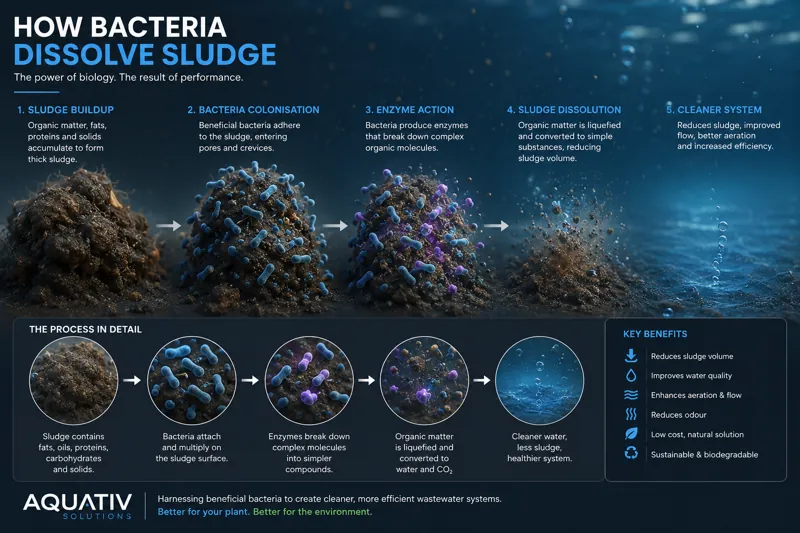
Industrial biological odour-control programs use selected microbial consortia, nutrients and supporting formulations to enhance the natural biological degradation already occurring within the wastewater system. Rather than covering the odour, beneficial bacteria metabolise the organic materials that create it.
Depending on the application and formulation, the biological process may help break down fats, oils and grease, proteins, carbohydrates, organic sludge, volatile fatty acids, residual food materials and other biodegradable organic compounds. The objective is a stronger and more stable microbial ecosystem capable of processing the incoming waste before it becomes septic.
The treatment sequence is straightforward: product is introduced, beneficial microorganisms establish, organic waste is degraded, odour generation decreases and system performance improves.
Treating hydrogen sulphide and ammonia at the source
Hydrogen sulphide is commonly associated with septic wastewater and anaerobic degradation. It is recognisable by its rotten-egg smell and creates serious corrosion and workplace exposure risks at elevated concentrations. A biological program can reduce the conditions that promote its formation.
- Accelerating the degradation of accumulated organics
- Reducing septic sludge deposits
- Improving microbial competition
- Supporting more stable wastewater conditions
- Reducing the availability of readily degradable material that drives sulphide production
Ammonia and nitrification
Ammonia-related odours often indicate insufficient nitrification, high nitrogen loading, inadequate aeration, low alkalinity, toxicity or insufficient retention time. A biological solution cannot compensate for a fundamentally undersized or poorly operated treatment plant, but it can support nitrifying populations and improve system resilience when the broader process conditions are suitable.
Benefits extending beyond odour reduction
A properly managed biological program usually delivers more than the immediate odour outcome.
- BOD and COD reduction, easing load on downstream processes.
- FOG management in drains, grease traps, balance tanks and industrial systems.
- Sludge management through improved biological breakdown.
- Better settling from a healthier microbial population and stronger floc development.
- Support for nitrification after toxic shock, plant upset or loss of biomass.
- Lower chemical reliance and reduced handling requirements.
- Infrastructure protection through lower H2S generation and corrosion risk.
- Improved compliance resilience under changing organic loads.
Where biological odour management applies
Biological odour-control strategies adapt to a range of industrial and commercial environments: industrial wastewater plants at food and beverage sites, abattoirs, rendering plants and dairies; municipal pump stations, aeration basins, sludge-holding tanks and collection networks; grease traps and commercial drains in restaurants, kitchens and hospitality; aerobic and anaerobic lagoons with sludge accumulation or localised septic zones; and composting and organic-waste facilities where enclosed areas benefit from improved biological degradation.
Biological treatment still requires proper engineering
Biological products are not a substitute for good wastewater management. For microorganisms to perform, the system has to provide suitable conditions.
- Adequate temperature
- Appropriate pH and alkalinity
- Sufficient retention time
- Effective mixing
- Suitable dissolved oxygen where aerobic treatment is required
- Balanced carbon, nitrogen and phosphorus
- Controlled exposure to sanitisers, disinfectants and toxic chemicals
- A dosing strategy aligned with hydraulic and organic loading
From odour suppression to system optimisation
The most effective programs start with an assessment of the process, not the selection of a product. That means reviewing flow, BOD, COD, TSS, FOG, ammonia, pH, dissolved oxygen, ORP, sludge depth and chemical discharge patterns before dosing anything.
The commercial question should not be 'how quickly can we cover the smell?' It should be 'what is causing the odour, and how do we prevent it from being generated?' Short-term suppression may still have a role during emergencies, maintenance events or temporary upsets. A long-term strategy focuses on reducing the organic and biological conditions responsible for recurring odours.
By combining specialist bacteria, targeted nutrients, appropriate dosing and process monitoring, facilities can move from repeated reactive treatment toward proactive wastewater management. The result is not simply a better-smelling facility. It is a more stable system with lower operational risk, improved asset protection and stronger environmental performance.
The bottom line
Do not just mask the problem. Identify the source and treat the system. Aquativ develops industrial bacteria and nutrient based solutions designed to support odour reduction, organic waste degradation, sludge management and wastewater treatment performance. Eliminate odours. Improve performance. Sustain the future.

Related Aquativ solutions
Explore the programs behind the field notes above.
Product range
Biological programs for home, commercial and industrial systems.
ExploreAll wastewater sectors
Eight sectors, from septic to abattoir and municipal plants.
ExploreIn-situ desludging
Microbial plug programs for aerobic and anaerobic lagoons.
ExploreGrease trap treatment
Biological FOG control for kitchens and food venues.
Explore