
Bacteria reseeding after wastewater shock loads

Wastewater treatment plants are living systems. They run well when the microbial community is diverse, balanced and matched to the incoming load. They run badly - sometimes catastrophically - when something disturbs that community faster than it can adapt. Reseeding is the practice of reintroducing selected microbial cultures to accelerate recovery after such a disturbance.
What a shock load actually does
A shock load is any event that pushes the biology outside its operating envelope quickly enough that it cannot adapt. The most common causes on Australian sites are a slug of high-strength waste from a production line cleanout, a pH excursion from a CIP discharge, a temperature drop during a cold front, a solvent or biocide carryover from upstream, or simply a long low-load period over a holiday shutdown.
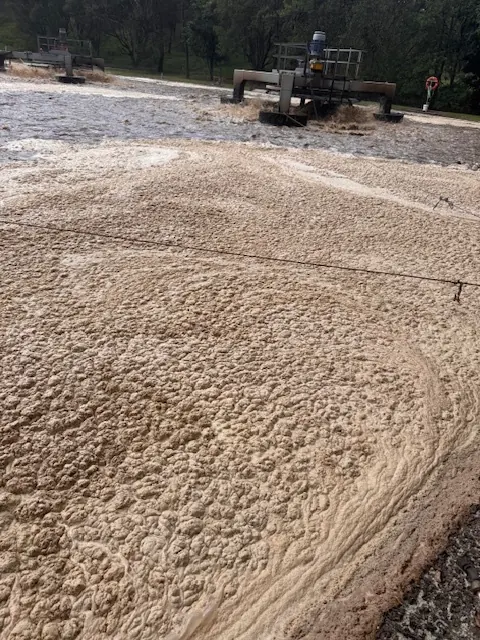
The visible symptoms are familiar: rising effluent BOD or ammonia, loss of floc structure, foaming, bulking, odour, and a clarifier that suddenly stops clarifying. Underneath those symptoms, the microbial community has lost the populations that were doing the work - nitrifiers in particular, which grow slowly and recover slowly.
Why natural recovery is slow
Left to itself, an upset plant will recover. The question is how long it takes and what it costs in the meantime. Nitrifying bacteria double roughly every 24 to 36 hours under good conditions, and much more slowly under stress. Rebuilding a functional nitrifying population from a damaged baseline can take three to eight weeks. During that window the plant is non-compliant, the operator is firefighting, and the regulator is paying attention.
What reseeding contributes
Reseeding introduces a concentrated, viable population of the organisms the plant needs - typically a blend of heterotrophs to rebuild floc structure and nitrifiers to restore ammonia removal. The reseeded organisms do not replace the existing community; they accelerate its recovery by providing a working population while the indigenous community rebuilds.
- Heterotrophic blends rebuild BOD removal and floc formation within days rather than weeks.
- Nitrifier-rich cultures restore ammonia oxidation while the indigenous nitrifiers re-establish.
- Anaerobic cultures restart methanogenesis in digesters after a souring event.
When to reseed and when not to
Reseeding is most effective when the cause of the upset has been removed. Dosing cultures into a plant that is still receiving the toxic slug, or that is still outside its pH or temperature envelope, simply wastes the inoculum. The sequence that works is: identify and stop the cause, stabilise the environment, then reseed and feed.
It is also worth being honest about what reseeding cannot do. It cannot compensate for an undersized plant, a broken aerator, or a chronic toxic input. It is a recovery tool, not a substitute for design or maintenance.
A practical recovery protocol
On most municipal and industrial plants, a workable recovery protocol involves an initial high-dose seed across the aeration basin, followed by a tapered maintenance dose for seven to fourteen days while the indigenous community rebuilds. Operators monitor MLSS, SVI, ammonia and nitrate daily and adjust aeration and wasting to support the new biomass. The plant is typically back inside compliance limits in days rather than weeks.
Related Aquativ solutions
Explore the programs behind the field notes above.
Product range
Biological programs for home, commercial and industrial systems.
ExploreAll wastewater sectors
Eight sectors, from septic to abattoir and municipal plants.
ExploreIn-situ desludging
Microbial plug programs for aerobic and anaerobic lagoons.
ExploreGrease trap treatment
Biological FOG control for kitchens and food venues.
Explore